





What if a paid brand story could earn attention without reading like a conventional advert? Sponsored Feature Articles can connect a brand’s expertise, product or progress with a subject readers already care about. To work, the story needs to offer genuine value as well as serve a commercial purpose. For South African brands, that means balancing a clear message with an engaging angle and making the paid placement transparent.
Thank you for reading this post, don't forget to subscribe!It’s reasonable to ask whether sponsored content could weaken audience trust, or how editorial storytelling can support business aims. The answer starts with a credible brief: put readers’ interests alongside the brand’s objectives instead of dressing a sales pitch in editorial language.
This guide explains what a sponsored feature can include, how to shape a compelling story angle and how to choose a publication suited to your intended audience. It also covers what to clarify before commissioning, including format, responsibilities, approvals and publication terms. Finally, it looks at how to assess results against realistic goals without assuming guaranteed reach. With the right groundwork, a paid feature can be transparent about its purpose and worthwhile to read.
Key Takeaways
- Distinguish a paid sponsored feature from a display advert and independent editorial coverage before choosing a format.
- Shape Sponsored Feature Articles around a defined brand objective, a specific reader and a story angle with genuine relevance.
- Compare features with interviews and display adverts to decide how much brand participation and messaging control your campaign needs.
- Agree disclosure, evidence, approvals and deliverables upfront, then assess content indicators separately from business outcomes.
- Consider Known Magazine Africa when your story fits its coverage of business, finance, economy, energy, lifestyle, fashion or events, and confirm the scope and terms before commissioning.
Sponsored feature articles: what they are and when South African brands use them
A sponsored feature is paid article content that tells a brand-related story in a publication, with the commercial relationship made clear to readers. Unlike a display advert, it uses a narrative and supporting detail. Unlike independent editorial, it is commissioned or funded by a brand and shouldn’t be mistaken for reporting produced independently of that relationship. The concept sits within Native advertising, where paid content takes a form suited to its publishing platform.
Sponsored feature articles are disclosed paid stories that connect a brand’s message to a subject readers may find useful or relevant. Their value lies in giving an announcement or area of expertise context. Publication doesn’t guarantee audience response, enquiries, sales or search rankings.
What makes a sponsored feature different from a traditional advert?
A display advert typically uses concise copy and visual elements to make a direct promotional point. A feature has more room to explain the thinking behind a development, introduce the people involved or explore its wider relevance. That context can help readers understand a brand story, provided the article offers substance beyond a sales pitch.
The distinction depends on transparency as well as format. Sponsorship should be recognisable, and paid content must not be presented as independent reporting. Before commissioning, clarify how the placement will be labelled and which claims or facts need substantiation.
When should a South African brand consider a feature article?
Paid coverage can be useful when a brand has a clear communication objective and a story that fits the publication’s subject matter. It isn’t automatically the right choice for every business or announcement. Start by identifying the purpose:
- Product launch: explain the need the product addresses instead of relying on a list of features.
- Company milestone: give customers or industry readers context on what the achievement represents and what comes next.
- Executive perspective: share informed views on a relevant challenge or opportunity in the sector.
- Sector development: show how the business is responding to a shift, using evidence and examples readers can assess.
Publication fit matters. A finance or economy feature may suit a business explaining its market expertise, while an energy story could provide context for an innovation or transition. Lifestyle and fashion coverage may be more relevant to brands with a genuine story in those areas. Choose the subject and angle for their relevance to South African readers, not simply because the placement is paid.
How sponsored feature articles turn a brand objective into a reader-first story
A strong feature doesn’t begin with a list of selling points. It begins with a communication objective, then finds the audience question or industry issue that makes the brand’s perspective relevant. For Sponsored Feature Articles, this distinction matters: the commercial goal guides the story, while reader value gives people a reason to read it.
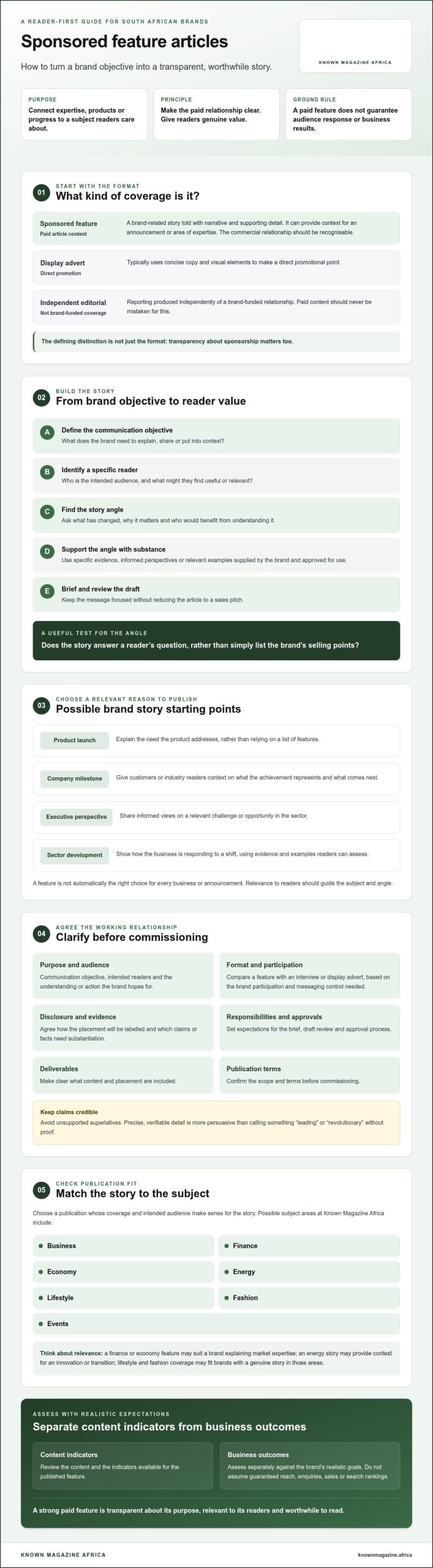
Move from campaign objective to publishable feature by defining the goal, identifying the reader, finding the story, agreeing the brief and reviewing the draft. Each step helps keep the message focused without reducing the article to a sales pitch.
How do you find a compelling angle for a sponsored feature?
Ask what has changed, why it matters and who would benefit from understanding it. For example, a company announcing a new capability could explain the problem it addresses and the expertise behind the development, rather than simply listing features. Support the angle with specific evidence, informed perspectives or relevant examples supplied by the brand and approved for use. Avoid unsupported superlatives. Precise, verifiable detail is more persuasive than calling something “leading” or “revolutionary” without proof.
What belongs in a sponsored feature article brief?
Make the brief practical enough to guide both the story and the working relationship. Include:
- Purpose and audience: the communication objective, intended readers and action or understanding the brand hopes to encourage.
- Story materials: the key message, proposed angle, supporting evidence, spokesperson and preferred publication context.
- Review boundaries: required sponsorship disclosure, approval contacts, asset permissions, exclusions and any sensitive claims needing substantiation.
- Agreed terms: deliverables, publication arrangements, review stages and reporting expectations, confirmed with the publisher before work begins.
Keep source material clear. Separate confirmed facts from claims supplied by the brand and questions that still need answers. Flag figures, comparisons or statements that require supporting evidence before they enter the draft. This helps prevent an engaging narrative from relying on details that can’t be verified.
Define brand review in advance. For paid content, an agreed review can help check names, dates, product details and factual accuracy. It shouldn’t be confused with control over independent editorial coverage. Confirm who drafts and edits the sponsored piece, what the brand may review, how corrections are handled and which publication terms apply.
For a prospective South African campaign, a clear brief also makes it easier to assess whether the story fits a publication’s subject areas and expectations. Brands considering Known Magazine Africa can discuss sponsored feature fit and scope before confirming the working arrangements.
Sponsored feature articles compared with interviews, display adverts and earned coverage
Choose a format according to the job the communication needs to do. A developed story, a spokesperson’s perspective, a concise visual message and independent editorial coverage each involve different levels of brand participation and control. This comparison can help clarify the distinctions.
| Format | Purpose and content | Brand participation and control | Disclosure |
|---|---|---|---|
| Sponsored feature | Tell a developed, contextual story through article content. | Brand commissions or funds the placement; review arrangements and messaging boundaries should be agreed. | Paid relationship should be clearly recognisable. |
| Brand interview | Present a spokesperson’s views or experience in a question-and-answer or interview-style format. | Brand provides a spokesperson; participation and review depend on the agreed arrangement. | If paid or sponsored, the commercial relationship should be clear. |
| Display advert | Communicate a concise message through visual advertising and short copy. | Brand supplies or approves the advert creative, subject to the publisher’s terms. | Presented as advertising. |
| Earned editorial coverage | Report or comment on a subject through an independent editorial decision. | A brand may provide information or respond to questions, but doesn’t purchase the placement or control the final coverage. | Not sponsored unless a separate commercial relationship exists. |
Sponsored feature article or brand interview: which format fits?
Choose a feature when the subject needs narrative context, supporting detail and a developed explanation of the brand’s perspective. An interview may fit better when the central value lies in a leader’s experience, expertise or direct response to a sector issue. Neither format inherently guarantees greater trust, visibility or conversion. The right choice depends on the story, intended audience and evidence available to support it.
Sponsored content or earned media: what should brands expect?
Sponsored content is paid placement, and its commercial relationship should be disclosed rather than disguised as independent reporting. Earned coverage is different: the publication makes its own editorial decision, and payment for a sponsored placement doesn’t buy or secure that coverage. Treat the formats as distinct, even if a broader communications plan uses both.
Let the objective guide the decision. If timing and agreed messaging control matter, a paid format may be appropriate. If independent editorial consideration is the aim, understand that the publication decides whether and how to cover the story. Sponsored Feature Articles, interviews and display advertising can complement other communications, but suitability depends on audience fit, message, evidence and the level of control required.
How to plan, approve and measure a sponsored feature article
A clear commissioning process protects the story’s credibility and the campaign’s purpose. Put the essentials in writing before work begins so the brand and publisher share the same expectations.
- Goal: State what the feature should help readers understand or consider.
- Audience and angle: Identify the intended readers and the story that makes the subject relevant to them.
- Evidence: Gather substantiation for factual claims, comparisons and figures, and confirm permissions for any supplied material.
- Disclosure: Agree how the paid relationship will be identified, and check current applicable South African guidance before publication.
- Approvals and deliverables: Name the people responsible for factual review, then confirm the article format, publication arrangements and any reporting in writing.
This checklist is a starting point, not a guarantee that every publisher offers the same formats, approval stages or reporting. Confirm what’s available and who is responsible for each step before commissioning Sponsored Feature Articles.
Which sponsored article metrics should a brand agree in advance?
Choose measures that relate to the objective, then ask whether the publisher can report them. Depending on what’s available, content indicators might include article views, engaged visits, referral clicks or social interactions. Agree who will supply the figures, how they’ll be defined and when they’ll be shared. Don’t assume reporting access, audience totals or performance benchmarks. Verify them directly.
Keep these indicators separate from business outcomes such as enquiries or sales. A referral click may show that a reader moved to a brand destination, but it doesn’t by itself establish that the article caused a later purchase. Use relevant measures together and consider other influences on campaign results.
How can brands protect credibility during review and approval?
Use review to check names, dates, product details, permissions and evidence for claims. Confirm the sponsorship label and its placement with the publisher, and verify current disclosure guidance rather than relying on assumptions. Keep approval focused on accuracy and agreed messaging. Paid content should remain recognisable as paid, not be made to look like independent reporting.
Planning a feature for a South African audience? Discuss sponsored feature story fit and scope with Known Magazine Africa, including which measures and reporting arrangements can be confirmed for your campaign.
Commission a sponsored feature article with Known Magazine Africa
Once you’ve established that a paid feature suits your objective, decide whether the publication and story are a genuine match. Known Magazine Africa is a South Africa-focused digital publication covering business, finance, the economy, energy, lifestyle, fashion and events. Its Sponsored Feature Articles may suit brands with a substantiated story in one of these subject areas, but the fit depends on the proposed angle and the publication’s current arrangements.
Is a Known Magazine Africa feature right for your brand?
Consider whether your story is timely, supported by evidence and relevant to readers interested in the subject. A business sharing expertise, an energy company explaining a development or a fashion brand with a meaningful industry story may have an angle to explore. The key is to give readers a reason to engage, not simply to announce that the brand has news.
Also assess whether a national South African digital publication suits your intended audience and communication goal. Publication alone doesn’t assure reach or response, so ask about the proposed placement and what information is available to help you assess its relevance. Story fit, agreed scope and current editorial arrangements all matter.
What should you prepare before making an enquiry?
A concise introduction helps the publisher assess the opportunity. Prepare:
- Company and campaign context: what the organisation does, the objective of the feature and who you want to reach.
- Proposed story angle: the change, insight or perspective that could make the subject useful to readers.
- Approved information: verified facts, supporting evidence, a suitable spokesperson and any claims that need careful substantiation.
- Assets and timing: relevant visual material with usage permissions confirmed, plus your preferred publication timing.
Then ask the publication to clarify the available format, scope, deliverables, writing and editing responsibilities, review stages, disclosure approach and publication terms. If reporting matters to your evaluation, ask which measures can be supplied, by whom and when. Confirm current terms directly rather than assuming a particular package, approval process or reporting arrangement is available.
A considered enquiry gives both sides a clearer basis for deciding whether the story is suitable and what commissioning would involve. If your brand has a substantiated story relevant to Known Magazine Africa’s coverage, contact the publication to discuss the proposed angle, audience and scope for a sponsored feature.
Make your next brand story count
The strongest Sponsored Feature Articles begin with a clear objective and an angle that gives readers useful context. Choose the format that suits your message, distinguish paid placement from independent editorial, and agree disclosure, approvals and deliverables before publication.
Measurement matters too. Decide which available content indicators relate to your goal, confirm what reporting the publisher can provide, and assess business outcomes thoughtfully rather than treating one metric as proof of impact.
For brands with a story that fits, Known Magazine Africa offers a potential publishing partnership through sponsored features. The South Africa-focused digital publication covers business, finance, the economy, energy, lifestyle, fashion and events, with its editorial team led by Chief Editor Bandile Mathebula. Discuss story fit, scope and current terms directly.
Discuss a sponsored feature article with Known Magazine Africa and explore whether your brand’s story belongs in its coverage. Start with a reader-first angle and clear expectations to decide whether the opportunity is right for your campaign.
Frequently Asked Questions
What is a sponsored feature article?
A sponsored feature article is paid content that presents a brand-related story in an article format within a publication. Unlike a display advert, it has room for context and useful detail. Unlike earned editorial coverage, it involves a commercial relationship. The article should make that relationship clear and offer readers more than a sales pitch. Publication doesn’t guarantee that readers will respond, enquire or buy.
Are sponsored feature articles the same as advertorials?
They’re closely related terms, although publishers may use them differently to describe paid, article-style brand content. Both can use a narrative format to explain a product, company or area of expertise, rather than relying on the concise visual message of a display advert. Before commissioning, ask the publication how it defines the format, what the article includes and how sponsorship will be identified.
Can a sponsored feature article build brand trust?
A sponsored feature can support a brand’s credibility when it shares useful information, uses substantiated claims and is transparent about its commercial purpose. It can’t guarantee trust. Readers may be sceptical if an article feels like a sales pitch or disguises paid content as independent reporting. Give the story a reader-relevant angle, provide evidence for claims and make the sponsorship clear so readers can assess the information in context.
How much does a sponsored feature article cost in South Africa?
There isn’t a single price that applies across South African publications. Request current rates directly rather than relying on general estimates. Cost and scope may depend on the publication’s terms and the agreed deliverables. Ask for the current price in rand and clarify what’s included, such as the article format, writing and editing responsibilities, approvals, publication arrangements and any reporting. Don’t assume reach or results are guaranteed.
How do you measure the success of a sponsored feature article?
Measure it against the objective you set before commissioning. Depending on what the publisher reports, content indicators might include article views, engaged visits, referral clicks or social interactions. Assess these separately from business outcomes such as enquiries or sales, and agree who will provide available data before publication. Avoid relying on one metric: a referral or enquiry alone doesn’t prove that the feature caused a business result.
Do sponsored feature articles need to be labelled as sponsored?
Paid content should be clearly identified so readers can recognise the commercial relationship. Agree the disclosure wording and placement with the publisher before publication, and check current South African Advertising Regulatory Board guidance and any applicable requirements rather than relying on assumptions. The label shouldn’t be hidden or presented in a way that makes the article appear to be independent editorial coverage. Clear disclosure helps readers understand the story’s context.
What should I send a publication when enquiring about a sponsored feature?
Send a concise company introduction, your campaign objective, intended audience and proposed story angle. Include approved facts, supporting evidence, a potential spokesperson and any visual assets you have permission to use. Share your preferred timing, then ask the publication to confirm available formats, scope, deliverables, disclosure, review stages, terms and reporting. These details help both sides assess the story’s suitability before you commit to a commission.