





What if the most prominent placement isn’t the right one for your campaign? When weighing sponsored content opportunities South Africa offers, start with the story you want to tell and the audience you hope to reach. A paid feature is more likely to feel relevant when its format, message and publishing context work together.
Thank you for reading this post, don't forget to subscribe!Choosing between an article, an interview, event coverage or a display placement deserves more than a quick comparison of formats. Each can support a different campaign purpose, but the right fit depends on your objectives and the publisher’s audience. Before committing, ask how the content will be presented and what information is available to help you assess its suitability.
This guide explores the sponsored opportunities available through Known Magazine Africa, a South African online publication covering business, culture and lifestyle. It explains how to compare formats against campaign goals and what to ask a media partner, including questions about current audience information, availability, rates, lead times, sponsored-content labelling and editorial review. Use it as a practical starting point for an informed enquiry.
Key Takeaways
- Explore sponsored content opportunities South Africa offers, from editorial-style features and interviews to event coverage and display ads.
- Match each format to your campaign objective, considering audience fit, the content input required and what evidence a publisher can provide.
- Prepare a brief that clarifies your intended audience, key message, timing and desired action.
- Before committing, ask publishers about current formats, availability, audience information, rates, lead times and sponsored-content labelling.
- Consider whether Known Magazine Africa’s coverage of business, finance, energy, lifestyle, fashion and events aligns with your brand’s story.
How Sponsored Content in South Africa Helps Your Brand
A brand story can earn attention when it fits a publication’s subject matter, not simply because it occupies space on a page. Sponsored content is paid brand material published in a media outlet’s context. It may use an editorial style, but it is not the same as ordinary editorial coverage, which is not commissioned by a brand as a paid placement.
A concise definition: Sponsored content is paid material created or placed to communicate a brand’s message within a publisher’s platform, with its commercial nature made clear to readers.
The term is often discussed alongside Native advertising, but the label alone doesn’t explain what a specific partnership includes. A publisher may offer a sponsored feature article, a brand interview, event media coverage or a display ad. Each has a different format, content process and set of deliverables. Before proceeding, ask how the placement will be labelled, what approvals are required, who supplies the material and how publication arrangements are agreed.
When exploring sponsored content opportunities South Africa has to offer, start with your campaign purpose and audience relevance, rather than choosing a format simply because it looks prominent. A feature may suit a detailed brand story; an interview can give a spokesperson room to share expertise; event coverage can focus attention on a particular occasion; and a display ad can present a direct visual message. The right option depends on what you want readers to understand or do, and whether the publisher’s subject matter is relevant to them. Request current audience information and details of the publisher’s process before assessing fit.
What counts as a sponsored content opportunity?
Publisher partnerships can include paid features, interviews and other placements, but a format’s name doesn’t guarantee identical content or control across publishers. A useful opportunity connects a clear brand message with a subject readers may find worthwhile, rather than treating every placement as an advertorial by default. Confirm the format, labelling, approval stages and publication arrangements in writing so expectations are clear on both sides.
Which South African brands might consider publisher partnerships?
National brands and SMEs may consider a publisher partnership when launching a product, sharing specialist knowledge or communicating a notable business development. Company size is less important than whether the publication’s subject coverage and intended readership align with the story. A business sharing energy expertise, for example, could explore publications that cover relevant subjects; a fashion brand may look for a stronger connection with lifestyle or fashion coverage. Neither fit nor results should be assumed. Ask the publisher for evidence that helps you evaluate the match.
Which Sponsored Content Opportunities Can South African Brands Explore?
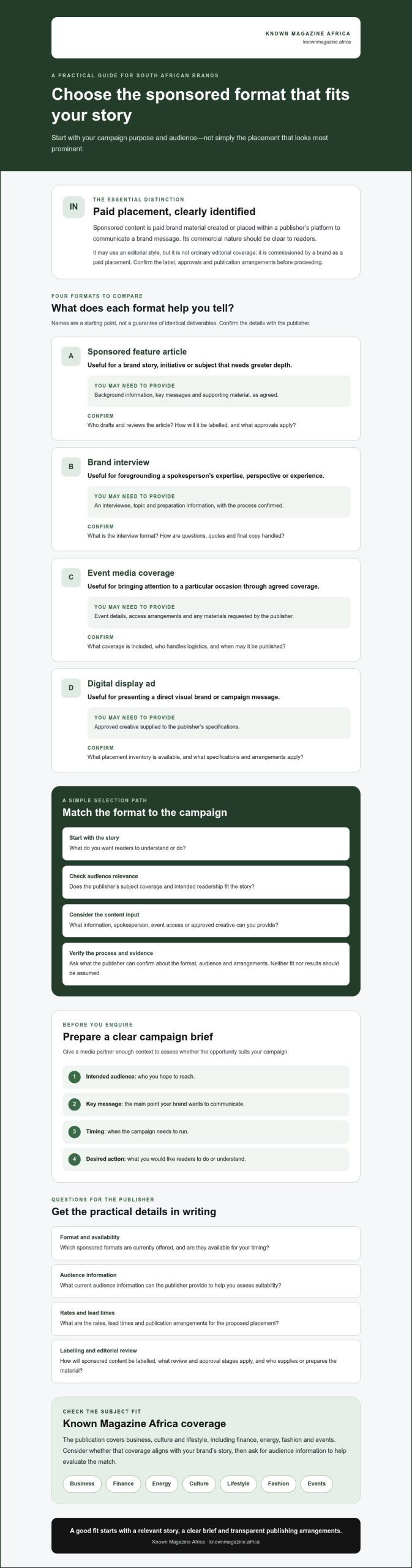
Four formats offer distinct ways to present a brand or campaign: sponsored feature articles, brand interviews, event media coverage and digital display ads. Their names are a starting point, not a promise of identical deliverables across publishers. Compare the options by the story you need to communicate, the material you can provide and the arrangements the publisher confirms.
| Format | Typical purpose | Content input | Questions to confirm |
|---|---|---|---|
| Sponsored feature article | Present a brand story, initiative or subject in greater depth. | Background information, key messages and supporting material, as agreed. | Who drafts and reviews the article? How is it labelled, and what approvals apply? |
| Brand interview | Foreground a spokesperson’s expertise, perspective or experience. | Interviewee, topic and preparation information, with the process confirmed. | What is the interview format? How are questions, quotes and final copy handled? |
| Event media coverage | Bring attention to an event through agreed coverage. | Event details, access arrangements and any materials requested by the publisher. | What coverage is included, who handles logistics, and when may it be published? |
| Digital display ad | Show a visual brand or campaign message in an available digital placement. | Approved creative supplied to the publisher’s specifications. | What inventory, dimensions, duration, reporting and availability can be confirmed? |
Editorial-style features, interviews and event coverage
A feature can give a brand narrative room to develop, while an interview puts a spokesperson or distinctive point of view at the centre. Event media coverage is different: its scope might involve reporting, photography or social amplification, but don’t assume any of these are included unless the publisher confirms them. Clarify deliverables, approvals, event logistics and publication timing before agreeing. For transparent partnership principles, consult IAB South Africa’s South African Content Creator Charter.
Digital display advertising and format fit
Display ads are visual placements, not sponsored editorial-style stories. They may suit a campaign seeking visibility through a publisher’s digital inventory, subject to actual availability. Don’t assume a particular position or audience outcome. Ask for the creative specifications, proposed placement, booking duration, reporting details and current availability so you can compare the option with content-led formats on clear terms.
Assess the sponsored content opportunities South Africa publishers offer against your campaign objective, not just the format. Known Magazine Africa lists sponsored features, brand interviews, event media coverage and digital display advertising. Explore its publishing opportunities and request current details before deciding which approach fits.
How to Compare Sponsored Content Opportunities Against Campaign Goals
A format can sound compelling and still be a poor fit if it doesn’t reach readers who care about your subject or support the action you want them to take. Compare sponsored content opportunities South Africa publishers offer against your campaign goal, then ask for current evidence instead of relying on assumptions about audience size, demographics or performance.
Use a current media kit or equivalent publisher information to assess audience profile and available reporting. Check when the information was prepared and what each measure represents. If a publisher can’t provide a detail, treat it as unknown rather than inferring likely reach or results.
Match each format to the outcome you want
For spokesperson visibility, consider whether a brand interview gives the relevant perspective room to come through. A sponsored feature may suit a broader brand narrative, while a display ad offers visual presence in available inventory. Event coverage is most relevant when your organisation has an event worth reporting; confirm its scope and any access or timing requirements. Ask the publisher to explain why the format fits your intended readers rather than assuming a match.
| Comparison point | What to assess | What to ask the publisher |
|---|---|---|
| Purpose | Does the format support awareness, spokesperson visibility or a more detailed brand story? | What campaign objectives is this format suited to, and why? |
| Content control | Which elements can your team review or approve? | Who develops the content, and what are the review and approval stages? |
| Required inputs | What people, information, creative or event access must you supply? | What do you need from us, and by when? |
| Evidence | Is there current information to evaluate audience and placement suitability? | Can you share your current media kit, audience profile and available inventory? |
| Measurement | Can the available reporting help you evaluate your stated objective? | What reporting measures are available, and when will they be provided? |
Assess credibility, disclosure and measurement
Reader trust depends on clear commercial disclosure. Ask how sponsored material will be identified, what editorial review applies and which current publisher policies govern the work. Check relevant advertising-disclosure guidance, including the Advertising Regulatory Board’s guidance where applicable, before publication. Agree success measures in advance. If your goal is visibility, define what evidence would help assess it; if your goal is a specific reader action, ask whether the publisher can report on a suitable measure. Don’t treat a metric as proof of business impact unless it directly supports that conclusion.
Publisher checklist: “Please confirm the audience information, available format and inventory, content inputs and approval process, disclosure and publication terms, rates, timing, and reporting measures for this opportunity.”
How to Prepare a Strong Brief for a South African Media Partner
A clear brief helps a publisher recommend a suitable format and gives your team a fair basis for comparing proposals. Start with the campaign objective, then define the audience, message, timing and action you want readers to take. For example, if your aim is to introduce a new financial service to business decision-makers, describe the relevant professional context rather than assuming a publisher can identify that audience without evidence.
Set the campaign objective and audience
Make the brief comparison-ready by recording what your brand knows before asking the publisher to fill in the gaps. Keep your core message focused and state any claims you can substantiate. Supporting facts, spokespeople and approved assets can help the publisher assess the opportunity, but confirm what materials are needed for the proposed format.
- Objective: What should the campaign communicate or achieve?
- Audience: Which interests, needs or professional contexts are relevant?
- Message and evidence: What should readers understand, and what approved information supports it?
- Timing: When would you like the campaign to run, and are there fixed dates?
- Desired action: What would you like an interested reader to do next?
A useful campaign brief states the audience, objective, key message, supporting evidence, timing and desired reader action.
Request a proposal that makes options comparable
Once the brief is ready, ask the publisher which format may suit it and what the proposed work includes. Separate your requirements from details only the publisher can confirm. You can state your preferred timing, approved message and available assets; the publisher should clarify possible formats, deliverables, availability, publication timing, editorial review and each party’s content responsibilities.
For a useful comparison, request the same information from each potential media partner. Ask for current audience evidence, such as a media kit or audience profile, along with available reporting measures and written commercial terms. Broad claims about placement or readership are not a substitute for details you can assess. If a proposal doesn’t specify what will be delivered or reported, ask for clarification before deciding.
Before sending, check that the brief is internally approved and that any product, service or performance claims are accurate and supported. Keep open questions visible, including scope, availability and details that depend on publisher review. This makes the initial enquiry more focused and reduces the risk of comparing proposals built around different assumptions.
Ready to put your brief into action? Send a campaign enquiry to Known Magazine Africa and ask about relevant formats, current audience information, availability and commercial details.
How to Explore Sponsored Content with Known Magazine Africa
For brands seeking a South African publisher whose coverage spans business and lifestyle, Known Magazine Africa may be worth considering. Its paid opportunities include sponsored feature articles, brand interviews, event media coverage and digital display advertising, alongside editorial coverage of business, economy, finance, energy, lifestyle, fashion and events. This breadth offers several possible subject contexts, but it doesn’t confirm audience fit or campaign availability.
Choose an opportunity that fits your story
Consider the role you need the publisher to play. A sponsored feature may suit a developed brand narrative, while an interview can bring a relevant spokesperson’s expertise or perspective forward. Event media coverage may fit when the event itself is central to the story; confirm the proposed coverage and logistics instead of assuming particular deliverables. If a visual message is the priority, ask whether a digital display placement is available and appropriate for your brief.
Match the subject to the publication’s coverage, too. A company sharing a finance or energy development might explore a context related to those subjects, whilst a fashion or lifestyle brand may consider the publication’s relevant editorial areas. These are starting points for discussion, not assurances about readership or outcomes. Ask for current audience information to help judge whether the publication is suitable for your intended readers.
What to include in an enquiry
A concise enquiry gives the publisher enough context to respond usefully without assuming every format follows the same process. Introduce your organisation and explain the campaign objective, intended audience, key message, preferred timing and action you hope readers will take. You can mention the opportunity you’re considering while inviting the publisher to suggest another format if it better suits the brief.
Request current media-kit information and ask about available formats, campaign availability, deliverables, editorial review, publication timing, commercial terms and reporting. Confirm rates directly, as well as what each proposed option includes. If the campaign involves an event, ask about access arrangements and precisely what coverage is in scope. These details help you assess the proposal on its merits rather than relying on assumptions.
The right partnership begins with a clear conversation, not a commitment. Share your objectives and ask which option may fit, then review the available information before deciding whether to proceed. To discuss your brief, explore sponsored content opportunities with Known Magazine Africa.
Turn Your Campaign Brief into a Strong Publisher Partnership
The right sponsored content opportunity starts with a clear purpose and a publication whose subject coverage suits your brand story. Compare formats by what they can help you communicate, what input they require and what the publisher can verify, rather than assuming a particular placement will deliver a specific audience or outcome.
As you explore sponsored content opportunities South Africa offers, prepare a concise brief with your intended audience, key message, timing and desired reader action. Then ask for current audience information, availability, deliverables, rates, editorial processes and reporting details so you can make an informed comparison.
Known Magazine Africa’s paid opportunities include sponsored features, interviews, event media coverage and digital display ads. Its coverage spans business, economy, finance, energy, lifestyle, fashion and events, offering possible contexts for a brand conversation. The best fit depends on your objective and the publisher’s current information.
Ready to discuss a potential fit? Discuss a sponsored content opportunity with Known Magazine Africa, share your campaign objectives and ask which formats may suit your brief.
Frequently Asked Questions
What sponsored content opportunities are available in South Africa?
Sponsored content opportunities South Africa publishers offer can include paid articles, interviews, event coverage and digital display advertising, although formats and deliverables vary. Known Magazine Africa lists sponsored feature articles, brand interviews, event media coverage and digital display ads. Ask for current availability, audience information, format details, rates and reporting before comparing options. Treat audience fit and proposed results as questions to verify, not assumptions.
How does sponsored content work in an online magazine?
Sponsored content in an online magazine is paid brand material published on the publisher’s digital platform. Depending on the agreed format, a brand may contribute information or creative material, while the publisher clarifies the content process, review stages and publication arrangements. Before agreeing, ask how the material will be identified as sponsored, what each party is responsible for and what reporting, if any, will be provided.
Is sponsored content different from native advertising?
The terms overlap, but they don’t always describe exactly the same thing. Sponsored content refers broadly to paid material created or placed for a brand in a publisher’s context. Native advertising describes advertising designed to fit the form or function of the platform where it appears. A sponsored article may use a native style, but terminology and formats vary. Ask the publisher how it defines the placement and how it will be labelled.
Can a South African brand arrange sponsored event coverage?
Yes, a brand can enquire with a publisher that offers event media coverage, but availability and scope need to be confirmed. Known Magazine Africa lists event media coverage among its paid opportunities. Ask what coverage is included, what access or information the publisher needs, and when publication may take place. Don’t assume photography, reporting or social amplification is included unless the publisher confirms it as part of the proposed arrangement.
How should a brand choose a sponsored content format?
Start with the campaign objective and the readers you hope to reach, then compare formats against the publisher’s subject coverage and current audience information. An interview may suit a spokesperson’s perspective, a feature a developed brand narrative, event coverage a relevant occasion, and a display ad a visual message. Ask the publisher to explain the format’s suitability and provide evidence you can assess. No format guarantees a particular audience response or result.
What should I include in a sponsored content brief?
Include your organisation’s name, campaign objective, intended audience, key message, preferred timing and the action you’d like readers to take. Add relevant supporting information, approved claims and any available spokespeople or creative assets, while making clear what still needs confirmation. Ask the publisher to specify proposed formats, deliverables, content responsibilities, review stages, availability, commercial terms and reporting. A concise, consistent brief makes proposals easier to compare.
How can a brand assess the performance of sponsored content?
Define what success means before publication, then ask the publisher which reporting measures are available and how they’re calculated. Depending on the placement, a report might include measures such as page views or clicks, but don’t assume these are offered or interpret them as proof of sales. Separate delivery measures from business outcomes, and agree how any campaign-specific tracking will work before committing to the placement.