






Funding headlines make for striking reading, but they rarely show what it takes to build a business that lasts. The most revealing South African startup success stories show progress through milestones: a product finding its market, a service adapting to customer needs, or a business making a deliberate choice about how to grow.
Thank you for reading this post, don't forget to subscribe!It’s fair to ask which South African startups have succeeded, especially when investment announcements can outshine the evidence of day-to-day progress. This guide looks beyond the publicity at ventures across fintech, digital banking, on-demand services and agricultural technology. It focuses on the decisions and developments behind their growth, while distinguishing documented milestones from signs that would need more evidence.
As you read, consider how the examples might inform your own venture: test a clear customer need, build for a particular market and adapt as your business evolves. Each journey has its own context, and none makes success a given. Together, these founders’ stories offer a grounded view of South African business progress, and a reminder that lasting momentum is built one milestone at a time.
Key Takeaways
- Assess startup progress through evidence such as sustained demand, product adoption and resilience, rather than treating a funding announcement as proof of lasting success.
- Explore South African startup success stories across fintech, on-demand services, agricultural technology, digital assets and banking to see how businesses address different needs.
- Look for the choices and milestones behind each company’s growth, and distinguish documented evidence from broader interpretation.
- Use customer understanding, market fit and thoughtful adaptation to inform your own approach, whatever your sector.
- Turn inspiration into a practical next step: identify one customer problem, one assumption to test and one measurable milestone.
What makes a South African startup success story worth telling?
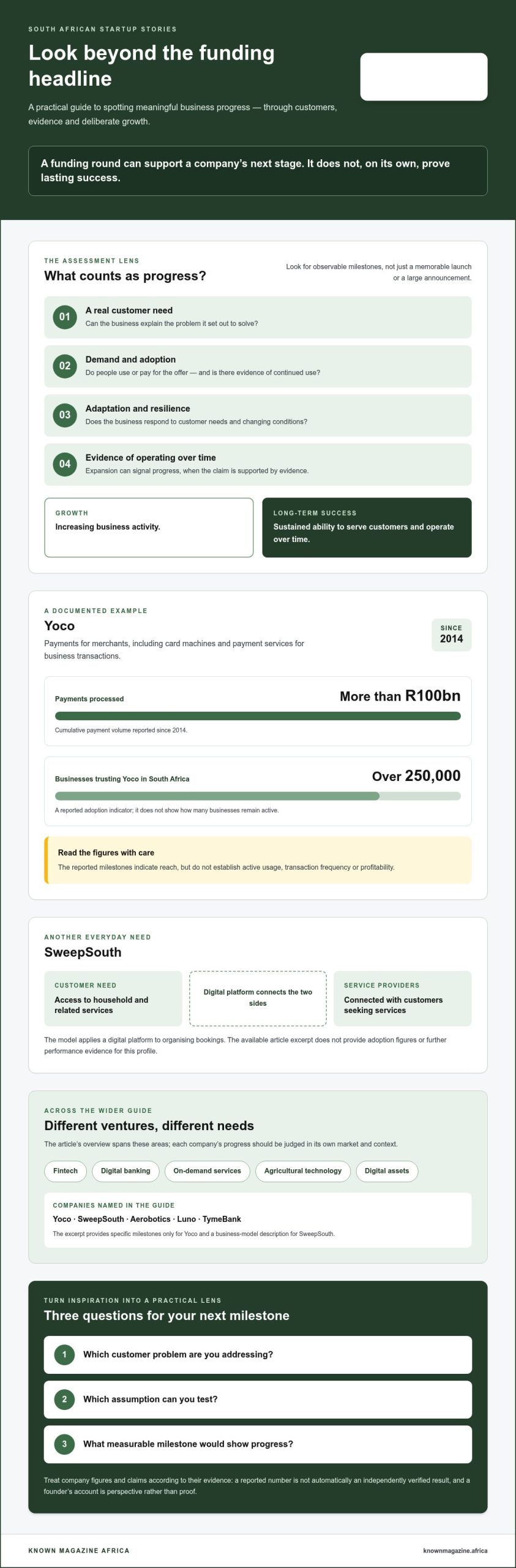
A compelling startup story needs more than a memorable launch or a headline-grabbing investment announcement. It should explain how a business responds to a real customer need, whether people continue to use or pay for its offer, and how the company adapts as it grows. Expansion and resilience can also signal progress, provided there’s evidence behind the claim.
Startup growth is evidence of increasing activity; proven long-term success is the sustained ability to serve customers and operate as a business over time. A funding round may provide resources for the next stage, but it doesn’t, on its own, demonstrate repeat demand, sound operations or lasting commercial viability. Valuations are snapshots shaped by particular transactions and assumptions, not guarantees of future performance.
This is a considered selection, not a definitive ranking of South African founders. The aim is to examine documented milestones and the business choices behind them, while recognising that no single measure captures every company’s progress.
How this roundup assesses business progress
Each profile is considered through the same practical lens: its South African founding connection, the customer problem it set out to address, the product or service it developed, and the milestones that can be substantiated. Where available, evidence of adoption, continued operations or expansion helps put those milestones in context.
Claims need careful attribution. A reported customer figure isn’t the same as an independently verified measure; an estimate isn’t a confirmed result, and a founder’s account offers perspective rather than automatic proof. Company status and time-sensitive details should be checked against current public information before publication. If reliable information is incomplete, state that uncertainty rather than filling the gap with an assumption.
Why South African context matters
A business grows within the conditions of the market it serves. Customer priorities, infrastructure and the practicalities of delivering a product can shape both the opportunity a founder sees and the operating choices that follow. Those conditions vary across sectors and audiences, so a successful approach in one setting shouldn’t be treated as a universal formula.
The wider backdrop includes public efforts to encourage high-technology industries and entrepreneurship, alongside South Africa’s evolving innovation ecosystem. The overview of innovation in South Africa offers useful context, but it doesn’t establish the performance of any individual business. Read these stories as distinct journeys: useful for identifying questions and strategies, not as proof that one company represents every founder or that its path can simply be repeated.
Yoco and SweepSouth: two South African startups built around everyday needs
Everyday friction can become a business opportunity when a product makes a recurring task easier. Yoco focuses on payments for merchants; SweepSouth applies a digital platform model to household and other services. Their different approaches offer a useful comparison, although the public milestones available here don’t tell the complete story of either company’s founding or prove long-term performance on their own.
Yoco: making payments simpler for businesses
Yoco serves merchants who need to accept card payments, with card machines and payment services designed for business transactions. The customer problem is practical: giving businesses a way to take electronic payments without relying solely on cash. Its product choice addresses that need directly, while payment activity offers a clearer indication of reach than a funding headline alone.
As reported in September 2026, Yoco had processed more than R100 billion in payments since 2014 and was trusted by over 250,000 businesses in South Africa. These are substantial adoption indicators, but they don’t reveal how many businesses remain active, how frequently they transact or how profitable the company is. The verified information available for this profile also doesn’t establish its founders or precise launch story, so those details shouldn’t be inferred from the milestone dates.
SweepSouth: organising access to household services
SweepSouth uses a platform to connect customers seeking cleaning and related services with service providers. The model makes booking and accessing services the central customer proposition, then extends it into adjacent needs. By September 2026, its listed services included home and office cleaning, speciality cleaning, outdoor cleaning, moving cleaning, elder care and supervised childcare. That breadth indicates an expanded service scope, but it isn’t, by itself, evidence of customer retention or financial sustainability.
The verified material for this section doesn’t establish the founders, founding date or current adoption figures, so those claims are left out rather than presented as fact. For context on the wider conditions that can shape company growth, Trade & Industrial Policy Strategies provides a broader account of the South African start-up sector.
| Company | Sector | Customer need | Business model | Verified milestone |
|---|---|---|---|---|
| Yoco | Fintech | Accepting electronic payments | Payment services and card machines for merchants | More than R100 billion processed since 2014; over 250,000 businesses reported as trusting it in September 2026 |
| SweepSouth | On-demand services | Accessing household and related services | Digital platform connecting customers and service providers | Service scope included cleaning, elder care and supervised childcare by September 2026 |
These South African startup success stories are most useful as examples of matching a product to a specific need, not as guarantees that the same model will work elsewhere. For more perspectives on business, finance and culture, explore Known Magazine Africa’s business coverage.
Aerobotics, Luno and TymeBank: innovation across different sectors
Technology can serve very different needs: helping agricultural businesses interpret information, giving customers access to digital financial services, or bringing banking functions online. These South African startup success stories are worth comparing by the problems they address, not by ranking them against one another. The public evidence available for each profile also varies, so claims about current ownership, customer numbers or performance need to be treated with care.
Aerobotics: applying data and technology to agriculture
Aerobotics is an agri-tech example, but the verified information available for this article doesn’t establish its current product details, intended customer groups or a dated business milestone. It would therefore be misleading to claim particular outcomes for growers or to present a technology description as independently confirmed. A complete profile should check current company materials and credible reporting to establish what the technology does, who uses it and what evidence of adoption is available.
There is one important operating consideration for any business using drones in South Africa. As of June 2026, commercial drone operators must register each drone and obtain a Remote Pilot Certificate under the regulatory context described in the available research. Those requirements are relevant to operating choices, but they aren’t evidence of Aerobotics’ own compliance or commercial progress.
Luno and TymeBank: building digital financial services
Luno focuses on digital assets, while TymeBank provides digital-first banking. They serve distinct customer needs and shouldn’t be treated as interchangeable fintech models. The verified information available here doesn’t confirm Luno’s current ownership or detailed founding history, so neither should be inferred. As of September 2026, Luno operated in more than 40 countries and offered tokenised US stocks and ETFs in South Africa and Nigeria. Those facts show geographic reach and product expansion, not the size or profitability of its South African customer base.
TymeBank’s evidence points to a different proposition: digital banking and savings. A March 2019 report recorded more than 80,000 customers signed up shortly after its official launch, an early adoption milestone rather than a measure of its present customer base. As of June 2026, its GoalSave account offered up to 11% interest per annum. The available facts establish a digital-first position and a dated early sign-up figure, but don’t detail its current operating structure or ownership.
Together, the three examples show why company profiles need more than a technology label or expansion headline. Ask what customer need is addressed, what evidence demonstrates adoption, and whether a milestone is historical or current. Where reliable details aren’t available, acknowledging the gap is more informative than presenting an assumption as proof.
What these South African startup success stories reveal about sustainable growth
The strongest common thread isn’t a single growth formula. It’s the relationship between a business and the need it aims to meet. Yoco’s reported payment activity and SweepSouth’s expanded service range offer different kinds of evidence; Luno’s international reach and TymeBank’s dated sign-up milestone point to adoption and expansion in financial services. These are useful signals, but they don’t all measure the same thing, and none alone proves profitability or long-term resilience.
That distinction matters. Funding can give a company room to invest, visibility can attract customers, and rapid expansion can open new opportunities. Yet each can also bring pressure: higher operating demands, more complex service delivery or the need to adapt a product for new customers. The South African startup success stories worth studying are therefore not simply the most prominent ones, but those whose evidence can be understood in context.
Which lessons can other founders adapt?
These principles can help founders ask better questions, but how they apply will depend on the sector, customer and stage of each business.
- Define the customer problem precisely. A payment service and a household-services platform address different needs. Identify who experiences the problem and how they currently solve it, then test whether your proposed offer genuinely helps.
- Measure behaviour, not buzz. Choose evidence that fits your model, such as repeat use, transactions or completed bookings. A sign-up, announcement or investment headline may indicate interest, but it doesn’t necessarily show sustained demand.
- Treat technology as a means, not the result. A digital platform or tool has value only if it works reliably for customers and can be delivered effectively. In agriculture, finance and services, the relevant measure of usefulness will differ.
- Adapt deliberately as the business grows. Expansion into new products, markets or services may create opportunity, but it also changes what a company must execute well. Test whether the next step strengthens the core proposition before treating growth as an end in itself.
Where success stories need careful interpretation
There’s a built-in blind spot in any roundup of visible companies: survivorship bias. Readers see businesses that reached recognisable milestones, not the full range of startups that struggled, changed direction or closed. A reported milestone is evidence of a particular event or scale at a particular time, not a complete account of commercial health.
Founder decisions can offer useful prompts, but they aren’t universal instructions. What suits a payments business may not fit a service platform or a digital bank; available evidence and current conditions also change. For further perspectives on business, finance and culture, explore Known Magazine Africa’s business coverage.
How South African founders can turn inspiration into their next step
A founder story can spark an idea, but its greatest value lies in the questions it prompts about your own customers and business. Rather than copying another company’s growth target or product, use the examples in these South African startup success stories as a starting point for a small, testable next step.
A practical framework for applying the lessons
Write down three things: one customer problem, one assumption behind your proposed solution and one measurable milestone. Keep each specific enough to test. For example, instead of assuming that customers want a new service, identify who might need it and ask how they currently address the problem.
- Define the need. Who experiences the problem, and what do they do about it now? Look for direct evidence from relevant customers rather than relying only on your own interpretation.
- Choose a small test. Show a potential customer a simple version of your offer, ask focused questions or test one part of the service. The purpose is to gather useful feedback before committing to a larger build or expansion.
- Set a suitable milestone. Choose a measure that reflects your business model, such as repeat use, completed bookings or transactions. Set a timeframe and decide in advance what result would support your next decision. Don’t borrow another startup’s target without considering your own stage, customers and operating conditions.
This exercise doesn’t guarantee a successful outcome. It can, however, help you replace a broad ambition with a clear question, a practical test and evidence you can use to decide what to do next.
Keep learning from credible business reporting
Before using a company as a benchmark, check when its information was published and whether its operating status, product range or ownership may have changed. Compare founder interviews with independent reporting and company disclosures where available. Each source has a different role: interviews can illuminate decisions and experience, while disclosures and reporting may help establish dated milestones or provide additional context.
Read figures carefully, too. A reported sign-up milestone, expansion announcement or funding round describes a particular development; it doesn’t automatically demonstrate profitability, repeat demand or resilience over time. If public information is incomplete, treat the gap as a reason for caution rather than filling it with assumptions.
For wider context beyond individual companies, explore African entrepreneurship coverage when it’s available, alongside business reporting relevant to your sector. To continue exploring South African and wider African business, finance and culture, read Known Magazine Africa’s business stories and interviews.
Turn a founder story into your next move
The most useful South African startup success stories reveal progress through more than funding or visibility. They show businesses responding to customer needs, building adoption and adapting as they grow. Their paths can offer valuable questions to consider, but they’re not guaranteed formulas: each founder’s next step depends on their customers, market and evidence.
Take one practical idea forward. Name a customer problem, identify an assumption you need to test and choose a measurable milestone suited to your business. Then check that the company information you’re using is current, and weigh reported achievements in context. A thoughtful test can be more useful than copying another venture’s headline target.
For further perspectives on business, finance and wider African developments, explore Known Magazine Africa’s articles, interviews and analysis. Explore Known Magazine Africa’s business stories and interviews to keep turning inspiration into informed action. Your next milestone starts with a question worth testing.
Frequently Asked Questions
Which South African startups are known for their success?
Examples featured here include Yoco, SweepSouth, Aerobotics, Luno and TymeBank, businesses working across payments, household services, agriculture, digital assets and banking. Their documented milestones differ: Yoco reported processing more than R100 billion in payments since 2014, while Luno operates in over 40 countries. These figures indicate activity or reach at particular points; they don’t establish profitability or prove that every company has achieved lasting success.
What makes a startup successful in South Africa?
Success is best assessed through evidence that a business solves a customer problem and can keep serving that need. Useful signals include sustained demand, product adoption, resilience and expansion, considered alongside the company’s operating context. South African startup success stories can offer ideas, but a funding round, valuation or burst of publicity isn’t enough to establish long-term performance. The most relevant measures depend on the company’s sector and business model.
How did Yoco become a recognised South African fintech company?
Yoco built recognition by providing payment services and card machines for merchants, addressing the practical need to accept electronic payments. As reported in September 2026, it had processed more than R100 billion in payments since 2014 and was trusted by over 250,000 businesses in South Africa. These dated figures demonstrate reported transaction activity and reach, but shouldn’t be read as proof of current active customers, profitability or future growth.
Is SweepSouth a South African startup?
Yes. SweepSouth is a South African-founded services platform that connects customers with service providers, beginning with household cleaning and expanding its listed services. As of September 2026, its scope included home and office cleaning, speciality and outdoor cleaning, moving cleaning, elder care and supervised childcare. That service range shows how the platform has developed, but it doesn’t by itself establish current customer numbers, retention or financial performance.
Can startup success stories offer useful lessons to new founders?
Yes, if founders treat them as prompts for investigation rather than formulas to copy. Look at the customer problem, the solution offered and the evidence that people use it. Then identify one assumption in your own business and test it with potential customers. Set a measurable next milestone that fits your model, such as repeat use or completed transactions, rather than adopting another company’s target without context.
What challenges do South African startups commonly face?
Challenges vary by sector and stage, so no single list fits every South African startup. Founders may need to secure suitable financing, reach customers, deliver reliably amid infrastructure constraints or meet sector-specific requirements. These are considerations, not universal obstacles or proof that a particular company experienced them. Assess the conditions relevant to your business, speak with customers and industry peers, and verify regulatory obligations through appropriate official sources.
How can I check whether a startup success story is up to date?
Check the publication date and compare key claims with recent company disclosures and credible independent reporting. Confirm whether the business is still operating, whether its ownership or products have changed, and when figures for funding, customers or revenue were reported. Treat founder interviews as valuable perspectives, but distinguish them from independently verified evidence. If current information is unavailable, note that uncertainty rather than assuming an old milestone describes the company today.