






Africa’s next business advantage may depend less on predicting change than on adapting to it market by market. For African business leaders, the question ahead of 2027 is not simply which trends will dominate, but which decisions can turn shifting conditions into resilient growth. The same force can create very different pressures and opportunities across the continent.
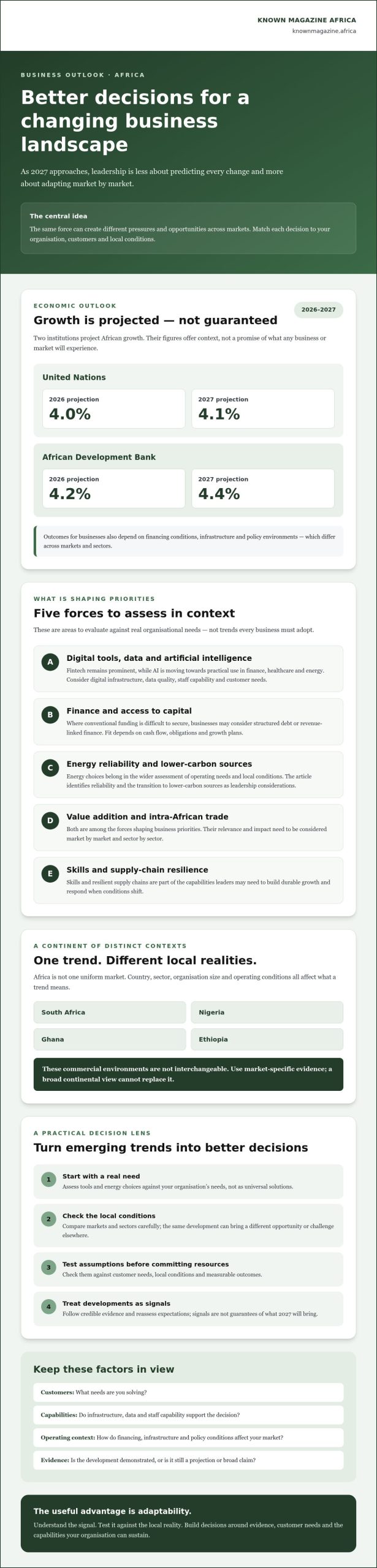
Thank you for reading this post, don't forget to subscribe!That complexity matters when reading the economic outlook. The UN forecasts African growth of 4.0% in 2026 and 4.1% in 2027, while the African Development Bank projects 4.2% and 4.4%, respectively. These are projections, not guarantees of what businesses will experience. Financing conditions, infrastructure and policy environments differ across markets and sectors.
This article explores forces shaping leadership priorities, from value addition and intra-African trade to artificial intelligence, renewable energy and evolving finance. It also considers the capabilities leaders may need to build durable growth, and the signals readers can follow as 2027 approaches. The aim is a grounded view of change across Africa’s varied business landscape.
Key Takeaways
- See how executives, founders, investors and other African business leaders shape priorities as the 2027 economy approaches.
- Assess digital tools and energy choices against your organisation’s needs rather than treating them as universal solutions.
- Compare markets and sectors carefully: a trend that creates opportunity in one context may present a different challenge in another.
- Before committing resources, test assumptions against customer needs, local conditions and measurable outcomes.
- Track credible developments as decision-making signals, not as guarantees of what 2027 will bring.
African Business Leaders in 2026: Why Their Choices Matter for 2027
As businesses weigh technology, energy reliability, access to finance and changing trade conditions, decisions made in 2026 can shape how organisations prepare for the year ahead. Those choices matter not because anyone can know precisely what 2027 will bring, but because decisions about investment, skills and operations influence how well a business can respond when conditions shift.
Africa’s business landscape is not one uniform market. South Africa’s commercial environment, for example, is not interchangeable with that of Nigeria, Ghana or Ethiopia. Priorities also differ between industries, established organisations and growing firms. A broad overview of the Economy of Africa can help readers place national business conditions in a wider continental context, but it cannot replace market-specific evidence. Context is essential when interpreting any trend.
In brief: African business leaders are decision-makers who shape how organisations allocate resources, respond to change and pursue sustainable growth within their particular market and sector.
Who counts as an African business leader?
The term includes executives guiding established companies, founders building growing businesses, investors directing capital and decision-makers in finance and emerging sectors. Their influence comes from the choices they make and the responsibilities they hold, not simply from public recognition. A visible profile, celebrity status or political office alone does not make someone a business leader. The relevant question is whether their role involves meaningful decisions about an organisation, its resources or its direction.
Leadership is not confined to the boardroom of a large corporation. A founder deciding which customer need to serve, or an investor assessing where capital can support durable value, also helps shape business activity. The scale and consequences of those decisions vary, so comparisons should account for each person’s role and operating context.
Why look ahead to 2027 now?
Looking ahead gives leaders and readers a chance to consider which signals deserve attention before strategic choices become urgent. This is analysis, not a forecast of certain outcomes or a definitive ranking of influential people. Current evidence can show what is already changing; expectations about 2027 remain possibilities to reassess as new information emerges.
For African business leaders, a useful approach is to ask how a development might affect a specific organisation, its customers and local operating conditions. Then watch for evidence that confirms or challenges the assumption. This article examines signals across markets and sectors, distinguishing observable developments from projections and broad narratives. The aim is practical perspective: a clearer way to understand leadership decisions as the next phase of economic change approaches.
The Forces Reshaping African Business Leaders’ Priorities
Technology, finance, energy, skills and supply-chain resilience are shaping business decisions across Africa, but their effects depend on the market, sector and organisation. The strategic challenge for leaders is not to adopt every emerging tool or trend. It is to identify which changes can solve a real business need and what capabilities are required to act on them.
Technology, data and financial innovation
Fintech remains a prominent area of innovation and investment across the continent, while artificial intelligence is moving towards practical use in sectors such as finance, healthcare and energy. These developments may change how organisations serve customers, process information and manage operations. But a trend’s prominence does not prove that it is delivering results in every business. Leaders should distinguish demonstrated use from projections or promotional claims, then assess whether digital infrastructure, data quality, staff capability and customer needs support the proposed investment.
Access to finance also shapes which ideas can move from trial to scale. Where conventional funding is difficult to secure, some businesses may consider alternatives such as structured debt or revenue-linked finance. The fit depends on the organisation’s cash flow, obligations and growth plans. Assess the financing model alongside the technology or expansion it is intended to support. The African Development Bank Group’s African Economic Outlook 2026 provides broader macroeconomic context; specific investment decisions still require evidence relevant to the business and country concerned.
Energy, talent and operating resilience
Energy reliability and the transition to lower-carbon sources are important considerations, but exposure is not uniform. A manufacturer dependent on continuous power, a digital service business and a firm operating in a market with different energy infrastructure may face distinct risks and options. Leaders can examine the reliability of their own supply, the operational consequences of interruption and the feasibility of alternatives before committing capital. No single energy response suits every organisation.
Workforce planning calls for the same precision. Rather than assuming skills are evenly available across markets or sectors, leaders can identify the capabilities their strategy requires, compare those needs with local hiring and training options, and invest in development where gaps emerge. Country-specific labour-market evidence is more useful than broad continental assumptions. Supply-chain resilience also merits close attention: mapping critical inputs and potential disruption points can help organisations decide where contingency planning is proportionate.
For African business leaders, the practical test is whether a proposed change strengthens a defined business outcome, such as reliable operations, customer access or workforce capability. Readers can explore related business and economy coverage for further context on the forces influencing decisions across South Africa and the wider continent.
One Continent, Many Contexts: Where Leadership Challenges Differ
Africa is not a single, uniform business environment, and a continental trend rarely tells the whole story. Policy settings, infrastructure, customer demand and access to capital can vary between countries, within countries and between firms in the same sector. For African business leaders, the task is to understand how those conditions intersect with their organisation, rather than assume a strategy that works in one market will transfer unchanged to another.
Why market context changes the leadership brief
National borders offer one useful frame, but they do not explain every difference. A large company and a small supplier may face different financing options, infrastructure constraints and customer expectations in the same country. Before comparing markets, leaders should ask what is being measured, for which businesses and at what date. Strategic analysis, including McKinsey’s Africa’s Business Revolution, can help frame the questions, but decisions still need evidence relevant to the organisation’s operating context.
The comparison below is a decision lens, not a ranking of countries. It highlights where leaders can seek comparable, current evidence before drawing conclusions.
| Factor | Context to compare | Scope and date |
|---|---|---|
| Policy and regulation | Applicable rules, policy direction and how clearly they are implemented for the relevant activity. | Country and sector; verify against current official material before acting. |
| Infrastructure | Reliability of power, connectivity and transport for the organisation’s actual locations and supply routes. | Operating site and supply chain; conditions may differ within a country. |
| Finance | Available funding, its terms and suitability for the firm’s cash flow and growth stage. | Business and funding type; distinguish policy rates from the borrowing terms a firm can access. |
| Market maturity | Customer needs, distribution, competition and readiness for the proposed product or service. | Target customer and sector; reassess as conditions change. |
How sector priorities shape decisions
The same external shift can lead to different operational choices. In finance, digital services may make customer access or transaction processes central questions. In energy-intensive operations, reliability and supply options may carry greater weight. A consumer business may instead prioritise affordability, distribution and changing preferences. These are lenses for investigation, not claims that every firm in a sector faces identical conditions.
Make comparisons specific and time-bound: define the market, sector and business type, then check whether the evidence is genuinely comparable. This discipline helps leaders distinguish a promising opportunity from a broad narrative and adapt strategy without treating the continent’s diversity as an obstacle to growth.
How African Business Leaders Can Turn Trends into Better Decisions
A trend is a prompt to investigate, not an instruction to invest. For African business leaders, a disciplined assessment can help separate a genuine opportunity from a compelling headline while protecting the organisation’s capacity to adapt if conditions change. The guidance below is an editorial framework, not universal business advice; each decision should reflect the organisation’s circumstances, expertise and responsibilities.
A practical framework for assessing a business trend
Use this three-step sequence before committing significant time, capital or operational change:
- Define the problem. State what the organisation needs to improve, then look for evidence that the problem exists. Check customer feedback, operational records or other relevant information rather than starting with a preferred solution.
- Test relevance and readiness. Consider whether the trend addresses that problem for your customers and in your market. Assess local operating conditions, available skills, infrastructure, funding and the organisation’s ability to manage the change. Include potential risks, governance responsibilities and effects on resilience, not only the possibility of growth.
- Run a proportionate test. Where appropriate, trial the response at a manageable scale. Set measures in advance, review results against the original problem and revise the assumptions before deciding whether to expand, adapt or stop.
Keep the evidence visible. A useful decision record identifies the source and date of key claims, the assumptions being tested, who is accountable and what result would trigger a change of course. This makes it easier to distinguish observed outcomes from expectations, especially when a trend is moving quickly.
Signals worth monitoring before 2027
Build a focused watchlist rather than tracking every headline. Follow relevant policy updates from official government or regulatory sources, technology developments with evidence of real-world use, investment announcements from their original publishers, and sector information that reflects your customers and supply chain. Check publication dates and definitions before comparing claims. Consistent measures across comparable reporting periods are more useful than juxtaposing different markets, samples or timeframes.
Review the watchlist at regular decision points. Ask whether new evidence changes the business case, risk assessment or capability plan. If the evidence has not changed, there may be no reason to change direction. If it has, update the decision deliberately rather than reacting to attention alone.
For further context on business, finance and economic developments across South Africa and the continent, explore Known Magazine Africa’s business coverage.
What to Watch as African Business Leaders Shape the 2027 Economy
The forces explored here point to a year ahead shaped by choices, not certainties. Digital tools, financing conditions, energy reliability, skills and trade opportunities may influence business priorities, but their effects will depend on where an organisation operates, whom it serves and what capabilities it can bring to the challenge. No single leader or market can represent the continent’s varied experience.
A balanced outlook for the year ahead
As 2027 approaches, watch for evidence that a trend is changing actual business decisions. Are organisations moving digital tools beyond trials and into defined operations? Are funding options meeting the needs of businesses at different stages? Are energy investments improving reliability as well as supporting transition? Do trade and manufacturing initiatives translate into practical opportunities for firms and their customers?
These are signals to follow, not promises of results. Policy shifts, geopolitical pressures, energy prices, investment flows and infrastructure conditions could all alter the outlook. Forecasts can help frame expectations, but they remain projections from their named publishers, based on assumptions that may change. An announcement or investment headline is not, by itself, proof of lasting impact. Look for implementation, measurable outcomes and evidence over time.
Questions readers can keep asking
- What is observable? Is a claim supported by primary-source data, documented activity or an attributable forecast, and are those categories clearly distinguished?
- Whose context is represented? Does the evidence relate to the relevant country, sector, business size and customer group, or is a local example being presented as a continent-wide pattern?
- What would change the decision? Which new information about policy, technology, capital, energy or customer behaviour would meaningfully alter the business case?
- How is performance being judged? Are measures consistent across reporting periods, and do they consider resilience, accountability and customer value as well as growth?
For African business leaders, the strongest outlook stays open to new evidence while remaining grounded in the organisation’s own conditions. A disciplined watchlist can help readers separate enduring shifts from momentary attention and recognise when assumptions need revisiting.
For continued perspective on the people, sectors and decisions shaping the continent’s economy, explore Known Magazine Africa’s business and economy reporting.
Turn the 2027 Outlook into Informed Action
The forces shaping the year ahead are interconnected, but their effects will vary across markets, sectors and organisations. Technology, finance, energy and workforce needs are best understood through evidence that reflects a business’s own customers and operating conditions, not headlines alone.
For African business leaders, the opportunity lies in staying alert without treating any forecast as certain: test assumptions, track meaningful signals and be ready to adjust as new information emerges. Resilient growth depends not only on spotting change, but on making deliberate choices that balance opportunity with risk, accountability and long-term capability.
Known Magazine Africa covers business, economy, finance and energy, with editorial coverage spanning South African and broader African developments. Explore business and economy stories from across Africa for further context on the people, decisions and shifts shaping the continent’s business landscape.
With a clear view of local realities and an openness to new evidence, leaders can approach 2027 with confidence and purpose.
Frequently Asked Questions
Who are considered African business leaders?
African business leaders are people who make decisions that shape organisations, investment or commercial activity across African markets. The term includes executives at established companies, founders of growing businesses, investors and decision-makers in finance and emerging sectors. Public visibility alone does not qualify someone; the focus is on their responsibilities and influence within a business. Their priorities vary according to the organisation’s size, sector, customers and operating environment.
What challenges do African business leaders face?
African business leaders may face limited access to finance, infrastructure constraints, political uncertainty and the complexity of operating in large informal economies. These pressures are not uniform: their impact depends on the country, sector, business size and supply chain. A firm reliant on dependable power may face a different operational challenge from a digital service or consumer business. Leaders need to assess local evidence and stakeholder needs before deciding which risks deserve priority.
Which industries are growing across Africa?
Areas attracting attention include fintech, renewable energy, digital services, artificial intelligence, e-commerce and local processing or manufacturing. This does not guarantee that every sector is growing at the same pace in every country. Investment announcements and forecasts should be distinguished from measured results. To assess an opportunity, examine its market, customer demand and evidence of implementation, then compare information from credible sources with the conditions facing the specific business.
How is technology changing business leadership in Africa?
Technology is changing how some businesses approach payments, customer service, data and operational processes. Fintech can support new ways to provide financial services, while artificial intelligence is being explored for practical use in sectors including finance, healthcare and energy. Adoption and outcomes differ by organisation and market. Leaders should check that infrastructure, data quality, staff skills and customer needs support a proposed technology before treating its promised benefits as established results.
How does the African Continental Free Trade Area affect businesses?
The African Continental Free Trade Area (AfCFTA) aims to support trade among participating African countries by establishing a framework for reducing barriers and improving continental market access. Its practical impact depends on implementation and the requirements that apply to particular goods, services and markets. The African Development Bank has estimated that full implementation could increase Africa’s economy by nearly $650 billion by 2043. That is a projection, not a guaranteed outcome for any individual business.
What skills will business leaders need in 2027?
No single skills list will suit every role, but leaders may benefit from stronger digital and data literacy, sound financial judgement and the ability to assess risk. Adaptability matters too: decision-makers need to test assumptions, understand customer needs and adjust plans as evidence changes. Communication, talent development and responsible governance can help organisations carry out change thoughtfully. Priorities should reflect the business’s strategy, sector and local operating conditions rather than a general prediction.
How can readers follow African business trends reliably?
Start with primary sources, such as official statistical agencies, central banks, regulators, government departments and established institutions that publish economic research. Check the date, geography and methodology behind each claim, and distinguish observed data from forecasts or company announcements. Compare like with like across reporting periods. Known Magazine Africa covers business, economy, finance and energy, with reporting on South African and broader African developments, offering editorial context alongside those original sources.
If your organisation has a story, launch or event to share, explore Known Magazine Africa’s sponsored features, brand interviews, digital display advertising and event media coverage.