




Her spoken-word poetry confronts resilience, self-belief and the conversations women have when nobody else is listening
Thank you for reading this post, don't forget to subscribe!
Women’s Month is often a time to celebrate the achievements and contributions of South African women. But for young author and literacy advocate Naledi Setzin, celebration also means creating space for women’s voices to be heard – particularly the thoughts, struggles, aspirations and emotions that often remain unspoken.
Setzin, a young South African author who self-published two books during her matric year, is bringing her literary voice into the Women’s Month conversation through three original spoken-word poetry pieces: “Anticipation”, “Inspire” and “Talk”.
The three works, drawn from her poetry chapbook Locked in a Suitcase, explore deeply human experiences through vivid imagery, introspection and rhythm – demonstrating the power of young South African writers to engage with conversations that extend far beyond the classroom.
Her literary journey began while she was still in matric, when she self-published Jacaranda Tree, a children’s story, alongside Locked in a Suitcase, a collection of poetry. Now, as South Africa reflects on the women who have shaped its past, present and future, Setzin is asking audiences to do something deceptively simple: Listen.
“Anticipation” explores emotional vulnerability, uncertainty and the moment when an individual realises that what they expected to be safe or comforting may not be what they imagined. Through striking ocean imagery, the poem moves between drowning and survival – capturing the experience of recognising danger, confronting it and finding a way towards shore.
“Inspire” takes a different direction, becoming an affirmation of ambition, creativity and self-belief.
With its repeated call to “Inspire, Admire, Desire”, the poem challenges readers to reject the pressure to shrink themselves and instead pursue what they aspire to become. It speaks to the importance of protecting one’s creative spirit and refusing to allow external pressure to extinguish personal ambition.

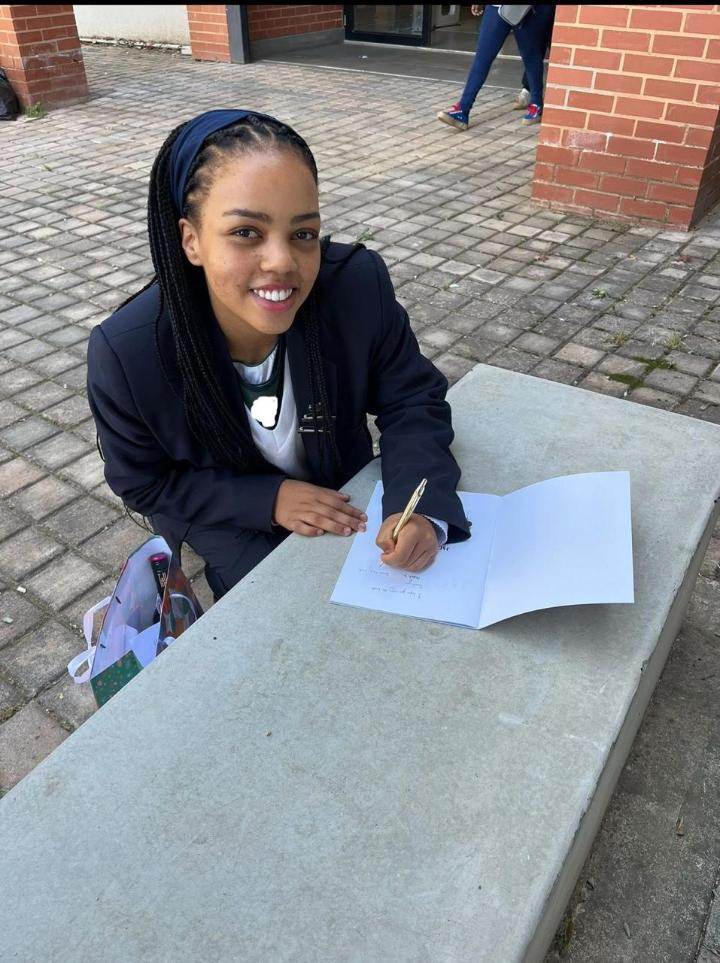
Then there is “Talk” – perhaps the most intimate of the three. The poem enters the solitude of one’s own thoughts, exploring the conversations that happen internally when there is no audience. It considers the power of speaking, reflection and finding direction through one’s own voice.
Together, the poems create a compelling portrait of the emotional landscape young people – and particularly young women – navigate as they find their voices.
What makes Setzin’s story particularly compelling is not simply the poetry itself, but the age at which she began building her literary legacy. While many young people were still deciding what they wanted their futures to look like, Setzin was already putting her ideas into published works.
Self-publishing two books during matric is a significant achievement in a country where literacy, access to books and youth participation in the literary sector remain important parts of the broader education and cultural conversation. Her journey demonstrates that young people do not have to wait for permission to become authors, storytellers or contributors to national conversations. They can create the platform themselves.
“I want my work to remind people that young voices matter. There is power in putting your thoughts into words, and sometimes the first person you need to speak to is yourself.” — Naledi Setzin
For Women’s Month, Setzin is making the three poems available as spoken-word audio pieces for radio and broadcast consideration, offering producers an opportunity to incorporate original South African poetry into their programming.
The soundbites can be used as part of Women’s Month features, cultural programming, youth-focused conversations, spoken-word segments or editorial discussions exploring the experiences and perspectives of South African women and young people.
The intention is not simply to add another Women’s Month message to the airwaves. It is to put a young South African literary voice on them.
“Women’s Month gives us an opportunity to celebrate women, but it should also challenge us to listen to what women are saying, what young women are experiencing and what the next generation wants to contribute,” says Setzin.
Naledi Setzin’s spoken-word recordings of “Anticipation”, “Inspire” and “Talk” are available for consideration by radio stations, television programmes, digital platforms and media houses looking to incorporate original South African poetry into their Women’s Month programming. Media can request the three audio pieces for editorial consideration, and select the work that best aligns with their programme or audience.